New ad products from Facebook and Twitter have given US mobile
advertising a boost, bringing revenues for the sector to more than $4
billion this year, a research firm said Monday.

Ultimate destination for technology lovers.
Showing posts with label Twitter. Show all posts
Showing posts with label Twitter. Show all posts
Tuesday, 18 December 2012

Monday, 17 December 2012
Twitter starts offering select users ability to download all their tweets
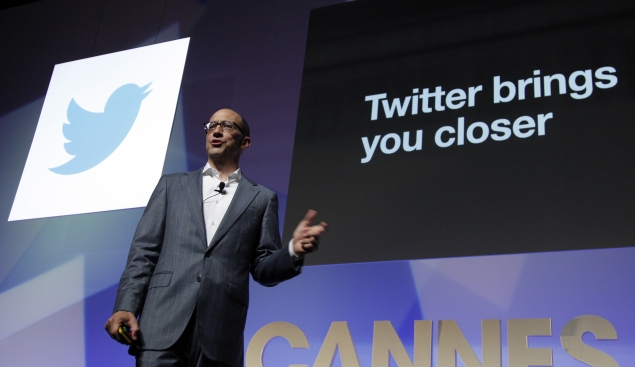
Twitter has started offering select users an ability to download all their tweets in one handy archive.
Confirmed: Twitter had agreed to buy Instagram before Facebook swooped in
Thursday, 13 December 2012
Twitter, Facebook becoming important tools in political debate: Survey
Social media like Facebook and Twitter have become important elements in
political and social discourse in a number of countries, particularly
in the Arab world, a survey showed Wednesday.
Obama tweet most popular, but Olympics ruled Twitter in 2012
An election victory tweet from President Barack Obama "Four more years"
with a picture of him hugging his wife was the most retweeted ever, but
the U.S. election was topped by the Olympics as the most tweeted event
this year.
Tuesday, 11 December 2012
Twitter introduces photo filters to take on Instagram, Facebook
Twitter
on Monday introduced the ability to add colour filters to user-uploaded
photos, a step that sharpened its budding rivalry with Facebook Inc.
Friday, 7 December 2012
See, what employers look for on Facebook, Twitter
Employers turn to social media sites like Facebook when deciding whether
to even call a job candidate for an interview, according to a new
study.
 Research from a global security software company discovered
that more than 90 percent of human resources professionals search for
unprotected social media profiles in order to assess a candidate's
suitability.
Thursday, 6 December 2012
Microsoft's #DroidRage Twitter campaign backfires, leads to #WindowsRage

"Do you have an Android malware horror story? Reply with #DroidRage with your best/worst story and we may have a get-well present for you."
-- Windows Phone (@windowsphone) December 5, 2012
While the campaign received some genuine responses, it wasn't long before it backfired on Microsoft, as people started sharing their horror stories related to Windows Phone, tagging them with #WindowsRage. Here are a couple:
"I once thought about writing malware for a @windowsphone but then I thought, aren't they suffering enough? #DroidRage #WindowsRage"
-- Mohammad Tarakiyee (@Tarakiyee) December 5, 2012
"You'll never get Malware from our Windows Store. You'll never find any third-party support either! #WindowsRage"
-- Ollie Reardon (@ojdon) December 6, 2012
This is not the first time Microsoft has targeted Google, though this is likely the first time things have gone wrong so spectacularly for Redmond. Microsoft held the #DroidRage campaign last year as well, with not-so-embarrassing results.
More recently, Microsoft attacked Google in a series of TV ads, describing the dominant search engine as a lousy holiday shopping guide in its latest attempt to divert more traffic to its Bing search engine. To punctuate its point, Microsoft warned consumers that they risk getting "scroogled" if they rely on Google's shopping search service.
Earlier, Microsoft launched a campaign called "Bing It On", trying to show web users the quality of its Bing search engine is better than Google's. The software company unveiled the site "bingiton.com" where users input five search queries and the unbranded search results of Bing and Google were shown in two columns. For each query, users were asked to choose a winner (or a draw) and the test showed which search engine come on top in the end.
Instagram shuts off Twitter feature

Facebook Inc's recently acquired photo-sharing service Instagram removed
a key element of its integration with Twitter, signaling a deepening
rift between two of the Web's dominant social media companies.Instagram
Chief Executive Kevin Systrom said Wednesday his company turned off
support for Twitter "cards" in order to drive Twitter users to
Instagram's own website. Twitter "cards" are a feature that allows
multimedia content like YouTube videos and Instagram photos to be
embedded and viewed directly within a Twitter message.
The move marked the latest clash between Facebook and Twitter since April, when Facebook, the world's no. 1 social network, outbid Twitter to nab fast-growing Instagram in a cash-and-stock deal valued at the time at $1 billion. The acquisition closed in September for roughly $715 million, reflecting Facebook's recent stock drop.
The companies' ties have been strained since. In July, Twitter blocked Instagram from using its data to help new Instagram users find friends.
Beginning earlier this week, Twitter's users began to complain in public messages that Instagram photos did not seem to display properly on Twitter's website.
Systrom confirmed Wednesday that his company had decided its users should view photos on Instagram's own Web pages and took steps to change its policies.
"We believe the best experience is for us to link back to where the content lives," Systrom said in a statement, citing recent improvements to Instagram's website.
"A handful of months ago, we supported Twitter cards because we had a minimal Web presence," Systrom said, noting that the company has since released new features that allow users to comment about and "like" photos directly on Instagram's website.
The move escalates a rivalry in the fast-growing social networking sector, where the biggest players have sought to wall off access to content from rival services and to their ranks of users.
"They're both competing for slices of the same pie, the pie being users' attention," said Ray Valdes, an analyst with research firm Gartner.
If Facebook decides to offer advertising on Instagram, it's important that the users visit Instagram's own website, said Valdes. "If the eyeballs are elsewhere, you have less to work with in terms of monetization," he said.
Photos are among the most popular features on both Facebook and Twitter, and Instagram's meteoric rise in recent years has further proved how picture-sharing has become a key front in the battle for social Internet supremacy.
Instagram, which has 100 million users, allows consumers to tweak the photos they take on their smartphones and share the images with friends, a feature that Twitter has reportedly also begun to develop. Twitter's executive chairman, Jack Dorsey, was an early investor in Instagram and had hoped to acquire it before Facebook CEO Mark Zuckerberg made a successful bid.
When Zuckerberg announced the acquisition in an April blog post, he highlighted Instagram's inter-connectivity with other social networks.
"We think the fact that Instagram is connected to other services beyond Facebook is an important part of the experience," Zuckerberg wrote. "We plan on keeping features like the ability to post to other social networks."
A Twitter spokesman declined comment Wednesday, but a status message on Twitter's website confirmed that users are "experiencing issues," such as "cropped images" when viewing Instagram photos on Twitter.
Wednesday, 5 December 2012
Pope gets more than half million Twitter followers

They included people ranging from the simple Roman Catholic faithful to a Jewish head of state.
"Your holiness, welcome to Twitter. Our relations with the Vatican are at their best & can form a basis to further peace everywhere," tweeted Israeli President Shimon Peres, who at 89 is four years older than Benedict.
The Vatican said on Monday that Benedict will start tweeting on mostly spiritual topics from December 12.
The pope actually has eight linked Twitter accounts. @Pontifex, the main account, is in English. The other seven have a suffix at the end for the different language versions. For example, the German version is @Pontifex_de, and the Arabic version is @Pontifex_ar.
On Tuesday afternoon, the English version had the most followers, with nearly 400,000. The next largest was Spanish, with some 93,000. The lowest number of followers was the Arabic, with about 3,500. Benedict's native German had about 10,000.
But the pope, leader of some 1.2 billion Roman Catholics, won't be following anyone but himself, the Vatican said.
A look at his official Twitter page on Tuesday showed that he is "following" seven people but they are merely versions of his own Twitter account in different languages.
The first papal tweets will be answers to questions sent to #askpontifex.
The tweets will be going out in Spanish, English, Italian, Portuguese, German, Polish, Arabic and French. Other languages will be added in the future.
The tweets will come primarily from the contents of his weekly general audience, Sunday blessings and homilies on major Church holidays. They will also include reaction to major world events, such as natural disasters.
He will push the button on his first tweet himself on December 12 but in the future most of the tweets will be written by aides, and he will sign off on them.
The Vatican, whose website has been taken down by hackers in the past, said it has taken precautions to make sure the pope's certified account is not hacked. Only one computer in the Vatican's Secretariat of State will be used for the tweets.
The pope's Twitter page is designed in yellow and white - the colours of the Vatican - and his picture over the backdrop of a St Peter's Square packed with pilgrims.
The page may change during different liturgical seasons of the year and when the pope is away from the Vatican on trips.
Tuesday, 4 December 2012
Study- Social networking taking up toilet time
 Blame social media the next time it feels like forever for your turn to use the toilet.
According to a study released Monday, 32 percent of people in the United States aged 18 to 24 say they use social networking in the bathroom.
The same report from marketing research firms Nielsen and NM Incite also found that 51 percent of US adults between 25 and 34 use social networking in the office more than any other age group.
While personal computers remain the primary tools for logging onto sites like Facebook and Twitter, the report posted at blog.nielsen.com noted a significant increase in the use of cellphones and tablets as well.
Forty-six percent of respondents said they used a mobile phone to connect online, up from 37 percent last year, while 16 percent used a tablet like Apple's iPad, up from just three percent in 2011.
Facebook remained by far the most popular social networking site among Americans but there was a stunning 1,047 percent year-on-year increase in the number of unique PC visitors to the online scrapbook Pinterest.
Subscribe to:
Posts (Atom)